


Horace Odes - Book III
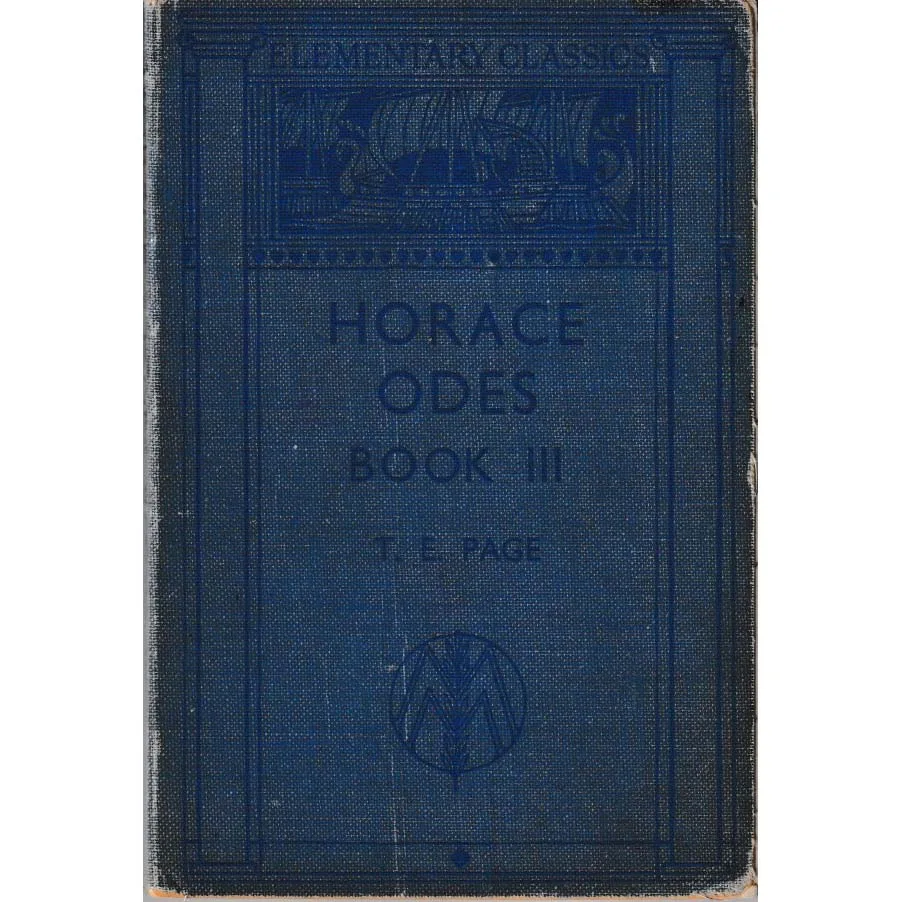
Publisher: MacMillan
Format: Hardback
ISBN: none
Horace, Odes — Book III (1949)
Editor: T. E. Page • Publisher: Macmillan
ISBN: none (numbers fear eternity)
Condition: Good (the well-behaved kind of Good)
Imprint: Crappy Old Books
Provenance: Ex–Croham Hurst School, Croydon (where Latin met drizzle and won)
Presenting the most upright of lyric citizens: Horace’s Odes, Book III, in the tidy schoolroom armour of a 1949 Macmillan. This is the book that taught generations to raise their morals and their quantities at the same time. Expect the Roman Odes to stand to attention (3.1–3.6, saluting Virtue and the State), then a quick flirtation with Lydia (3.9), a holiday at the spring of Bandusia (3.13—bring a wreath, possibly a goat), and the closing boast “exegi monumentum aere perennius” (3.30), which is Latin for “top that, paperback.”
Condition “Good” here means school-tested, teacher-approved. The boards show honest shelfwear, the spine is firm like a headmaster’s handshake, and the text-block has the comfortable ivory of a well-kept exercise book. You may find the classic badges of education: a Croham Hurst stamp, a pencilled shelf-mark, and the ghost of a checkout slip that remembers every detainment you never served. Pages turn with a soft, papery sigh; foxing is present in the courteous, after-tea quantity. If there are marginal notes, they are the helpful kind (“Sapphic! count the beats”) rather than the revolutionary.
Inside, T. E. Page does what T. E. Page does: just-so introductions, notes that land exactly where you need them, and scansion marks that behave like law-abiding citizens. Vocabulary is brisk, syntax is tamed, and the apparatus never once tries to be your friend—it simply helps you conquer Latin like an adult. The type sits in neat ranks; even the macrons look punctual.
As a reading copy, it’s excellent; as a relic, it’s practically a sixth-form time capsule. Hold it and you can hear the pencil sharpeners, the distant sound of rugger, and a voice saying, “Translate quietly and aspire to virtue.” Display it and your other classics will instinctively straighten their dust-jackets. Read it and you’ll acquire the serene Horatian habit of matching moral seriousness to metrical lightness—useful at parties and parliaments.
Ideal for: teachers who miss red pens, poets who prefer their lyrics with limestone and laurel, historians who like their propaganda metrical, and anyone who believes a life of moderation should still include wine, friendship, and a well-scanned Alcaic stanza.
Crappy Old Books guarantee: we don’t sell “mint”; we sell books with a past and a future. If you want sterile, try a laminate. If you want Horace in a school blazer from Croydon, still quoting lines that outlive bronze, this is your ode-to-go.
Keep browsing: See more Ancient Classics books Other books by TE Page
